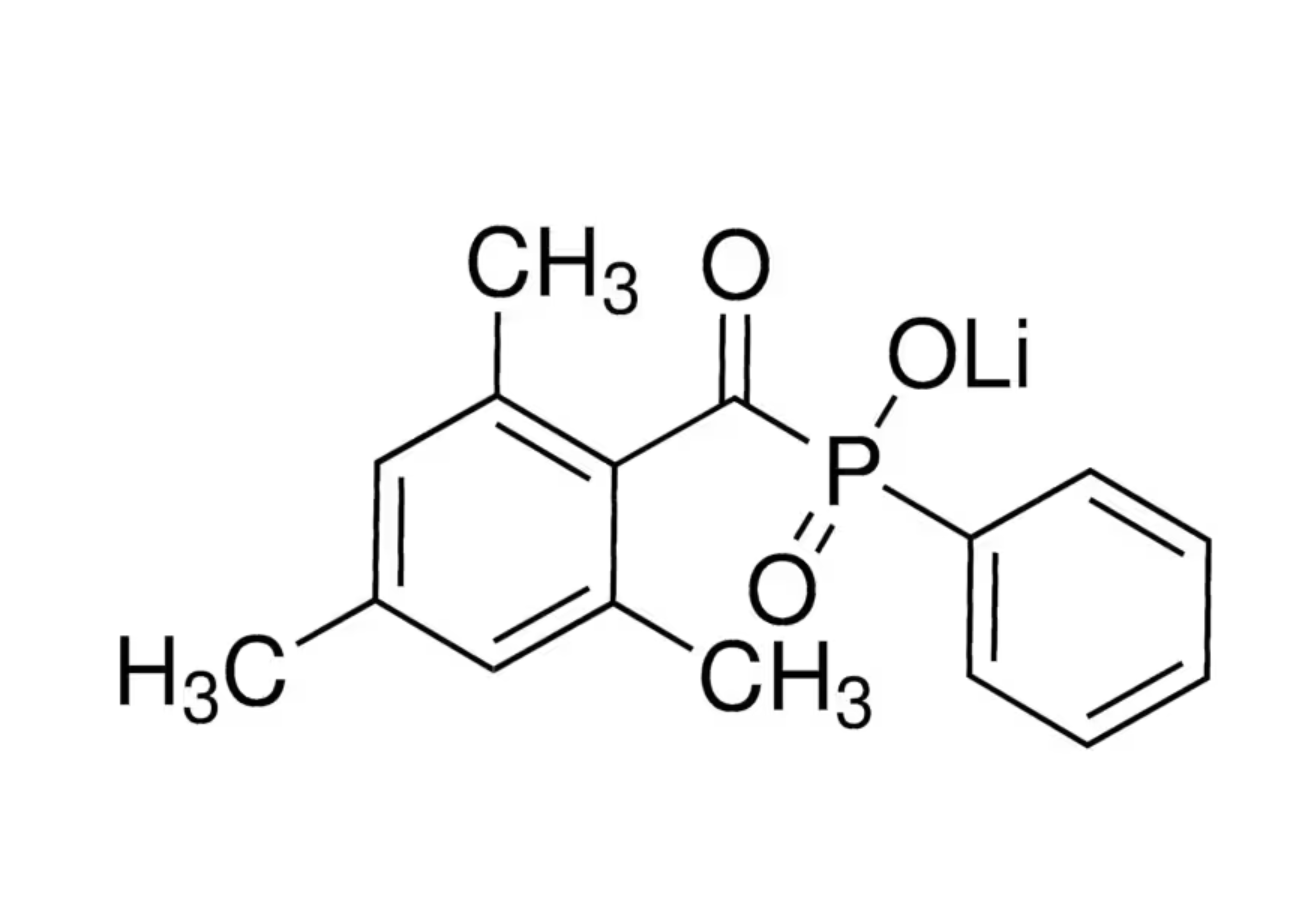
LAP Photoinitiator (Lithium phenyl-2,4,6-trimethylbenzoylphosphinate)
High-reactivity, water-soluble photoinitiator optimized for cell-friendly photocrosslinking of GelMA and other methacrylated hydrogels. LAP provides high absorbance at 405 nm (reactive across 365–420 nm), enabling rapid gelation at low light doses and reduced cytotoxicity. Each lot is quality-controlled for batch-to-batch consistency. For research use only.
Key Features
- Cell-friendly: rapid curing at low intensities (5–20 mW/cm²) with short exposures.
- 405 nm-optimized: excellent reactivity at 405 nm; compatible with 365–420 nm LED/DLP systems.
- Water-soluble: dissolves readily in sterile DI water to prepare 0.5–1.0% (w/v) stocks.
- Highly consistent: QC verified for purity, identity and performance.
- Bioprinting-ready: validated for extrusion, DLP, SLA and light-sheet workflows.
Typical Applications
- Photocrosslinking of GelMA and other methacrylated biomaterials
- 3D bioprinting (extrusion/DLP/SLA), micropatterning, microfluidics
- 3D cell culture, organoids, tissue-engineering hydrogels
Specifications
| Property | Details |
|---|
| Product name | Lithium phenyl-2,4,6-trimethylbenzoylphosphinate (LAP) |
| Synonyms | LAP photoinitiator; Lithium TPO-L salt |
| CAS | 85073-19-4 |
| Molecular weight | ~225.24 g/mol |
| Form | Lyophilized powder |
| Appearance | Off-white to light yellow powder |
| Solubility | Water-soluble; recommended to prepare 0.5–1.0% (w/v) stock solution |
| Working wavelength | Optimal at 405 nm; reactive range 365–420 nm |
| Recommended light dose | 5–20 mW/cm²; exposure 5–60 s (depending on formulation and thickness) |
| Endotoxin | Low endotoxin, QC-checked |
| Storage | -20 °C, dry, protected from light; aliquot to avoid repeated freeze-thaw |
| Shelf life | 12 months from receipt when stored properly |
| Research use | For research use only; not for human or clinical use |
Validated Systems
LAP has been tested in combination with GelMA and ECM-mimetic matrices for 3D culture of: C2C12, HUVECs, H9C2, cancer cell lines, L929 fibroblasts, primary cardiomyocytes, skeletal myocytes, hiPSCs and organoid models.
Preparation & Use
- Stock solution: dissolve in sterile DI water at 1.0% (w/v), filter-sterilize (0.22 µm), aliquot, and store at -20 °C protected from light.
- Working concentration: typically 0.01–0.10% (w/v); lower (0.025–0.05% w/v) for more sensitive cell types.
- Photocuring: expose to 365–420 nm light at 5–20 mW/cm² for 5–60 s depending on thickness and formulation.
- Critical: handle under minimal light, prepare fresh before use, and equilibrate to room temperature before application.
Safety
Use appropriate PPE when handling. Avoid inhalation, ingestion, and contact with skin/eyes. Protect from light. Dispose of waste according to local regulations. For research use only.
What’s Included
- LAP powder in selected pack size (500 mg / 1 g )
- Quick-start protocol