

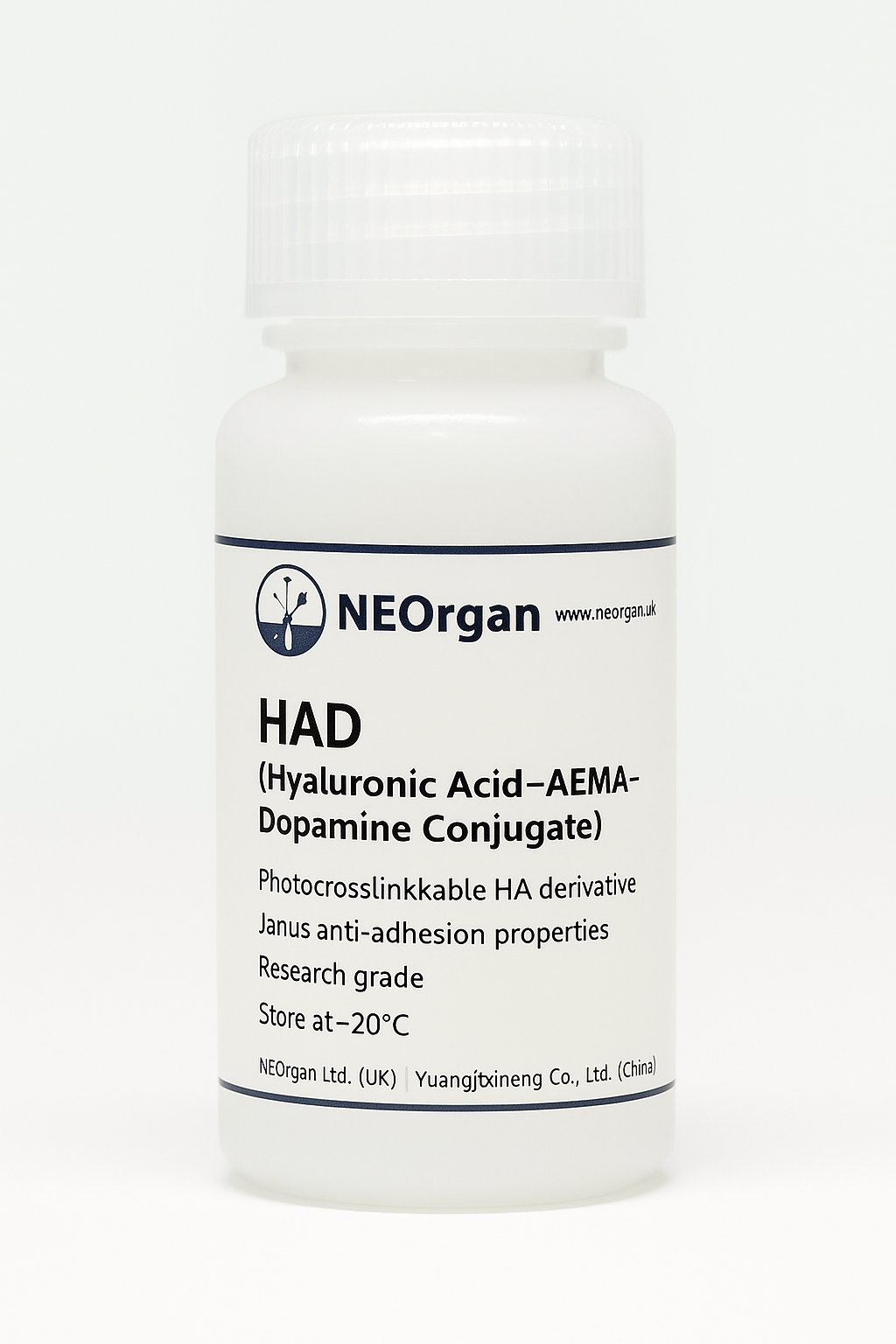
HAD
£290.00 – £2,320.00Price range: £290.00 through £2,320.00 No VAT charged
Description
Hyaluronic Acid–AEMA–Dopamine Conjugate (HAD), Photocrosslinkable Hydrogel
HAD is a photocrosslinkable hyaluronic-acid-derived macromer functionalized with 2-aminoethyl methacrylate (AEMA) and dopamine moieties.
The combination of methacrylate groups and catechol chemistry provides HAD with unique surface-regulating and biofunctional characteristics not achievable with standard HA or HAMA derivatives.
Upon light activation, HAD forms hydrogels with asymmetric adhesion properties (Janus behavior), enabling one side to strongly adhere to wet biological tissues while the opposite side remains non-adhesive and smooth. Additionally, the catechol groups allow interactions with macromolecules, supporting controlled and sustained release profiles.
HAD is supplied as a lyophilized powder for reconstitution, suitable for use in research applications such as bioadhesives, anti-adhesion interfaces, drug delivery, biofabrication, and tissue engineering. For research use only.
Key Features
-
Photocrosslinkable for rapid and tunable hydrogel formation
-
Catechol-functionalized (dopamine chemistry) for tissue adhesion
-
Janus interface capability — adhesive on one side, non-fouling on the other
-
Supports controlled macromolecule release
-
Derived from hyaluronic acid, biocompatible backbone
-
Supplied as lyophilized powder for flexible formulation
-
Compatible with UV / visible light photoinitiators (e.g., LAP)
Typical Applications
-
Bioadhesive hydrogel development
-
Anti-adhesion barrier materials
-
Controlled release systems
-
Janus hydrogels
-
3D bioprinting (specialized formulations)
-
Tissue engineering research
-
Photocrosslinkable biomaterial research
Specifications
| Product Name | Hyaluronic Acid–AEMA–Dopamine Conjugate (HAD) |
| Form | Lyophilized powder |
| Backbone | Hyaluronic acid (HA) |
| Functional Groups | Methacrylate (AEMA) & Catechol (Dopamine) |
| Crosslinking Method | Photocrosslinkable (UV/visible, LAP recommended) |
| Solubility | Soluble in water, PBS, culture buffers |
| Appearance | White to off-white solid |
| Purity | Research grade |
| Storage | -20°C (long-term); protect from moisture & light |
Validated Systems
HAD hydrogels have been evaluated in multiple preclinical research models for their anti-adhesion and tissue-interface properties, including:
-
Rat thoracic cavity (anti-adhesion study)
-
Rabbit abdominal cavity adhesion model
-
Bama miniature pig thoracic and abdominal adhesion models
These studies demonstrated the material’s ability to form a non-adhesive Janus interface while maintaining strong tissue anchoring on the adhesive side, supporting its use in advanced biomaterial and tissue-interface research.
What’s Included
- HAD powder in selected pack size
- Quick-start protocol